


Description
Onkyo Muse Y-50 Network Streaming Integrated Amplifier
The Onkyo Muse Y-50 is a powerful two-channel network streaming integrated amplifier that brings music services, HDMI-connected television and gaming audio, vinyl playback and room correction into one compact hi-fi component. Its Axign Class D amplifier delivers 250 watts per channel into 4 ohms under the stated test conditions, with a 5.46-inch colour display for clear everyday operation.
Built for a stereo system that serves as the main music and entertainment setup, the Muse Y-50 combines an integrated amplifier, network streamer, phono stage and useful digital inputs. You can connect a pair of suitable passive speakers, a compatible turntable, a television and other sources without requiring a separate streamer or AV receiver.
Compared with the Muse Y-40, the Y-50 adds greater rated amplifier output, an HDMI video input and output, moving-coil as well as moving-magnet phono compatibility, a dedicated subwoofer output and Onkyo Room EQ. These are worthwhile upgrades for customers building a more complete two-channel system, particularly where television and a subwoofer also play a role.
Axign Class D Amplification
Strong output from a compact stereo chassis
The Y-50 uses a fully digital amplifier architecture with Axign Class D processing and MOSFET output devices. The Australian-region specifications rate it at 250 watts per channel into 4 ohms at 1kHz and 0.7% THD with both channels driven, or 125 watts per channel into 8 ohms from 20Hz to 20kHz at 0.08% THD with both channels driven.
These figures provide useful headroom for many bookshelf and floorstanding speakers, but speaker matching involves more than power alone. Sensitivity, impedance behaviour, room size and typical listening level should guide the choice. The Audio Experts can help plan a suitable pairing without reducing the decision to a single wattage figure.
Streaming and Network Music
Select music from familiar platforms
Spotify Connect, TIDAL Connect, Qobuz Connect, Apple AirPlay 2 and Google Cast allow compatible devices and apps to send music to the amplifier over the home network. Wi-Fi and Ethernet are supported, alongside Bluetooth playback using SBC and AAC codecs.
A wired Ethernet connection is worth considering for a permanent installation, especially where several networked devices operate in the same living area. The Onkyo Controller app adds convenient access to settings and operation. Streaming subscriptions and compatible devices may be required.
HDMI for Television and Gaming
A proper stereo system can handle everyday video sources
Unlike a conventional stereo amplifier with only audio connections, the Muse Y-50 includes an HDMI input and HDMI output with ARC support. The HDMI path supports video features including up to 4K/120p and 8K/60p pass-through, with VRR and ALLM among the specified capabilities. This makes the Y-50 attractive when a game console or other compatible HDMI source needs to share the main stereo speakers.
HDMI ARC can also return sound from a compatible television to the amplifier. As this is a two-channel amplifier rather than a surround sound AV receiver, television and source devices may need to be set to an appropriate stereo audio output mode. Check cable capability and the video settings of connected equipment when planning a 4K/120p or 8K setup.
Onkyo Room EQ
Adjust the system to the listening environment
The Y-50 includes Onkyo Room EQ, a room-calibration system developed for the Muse Series. Its purpose is to account for aspects of the listening environment and apply corrective processing rather than leaving the final balance entirely to speaker positioning and manual tone controls.
Room correction is most useful after the speakers and listening position are sensibly arranged. It cannot correct poor speaker placement or unsuitable room layout on its own, but it gives the Y-50 another tool for achieving a better-integrated stereo system. Confirm the current calibration setup requirements and supported software during installation.
MM/MC Phono and Conventional Audio Sources
Bring existing hi-fi equipment into the system
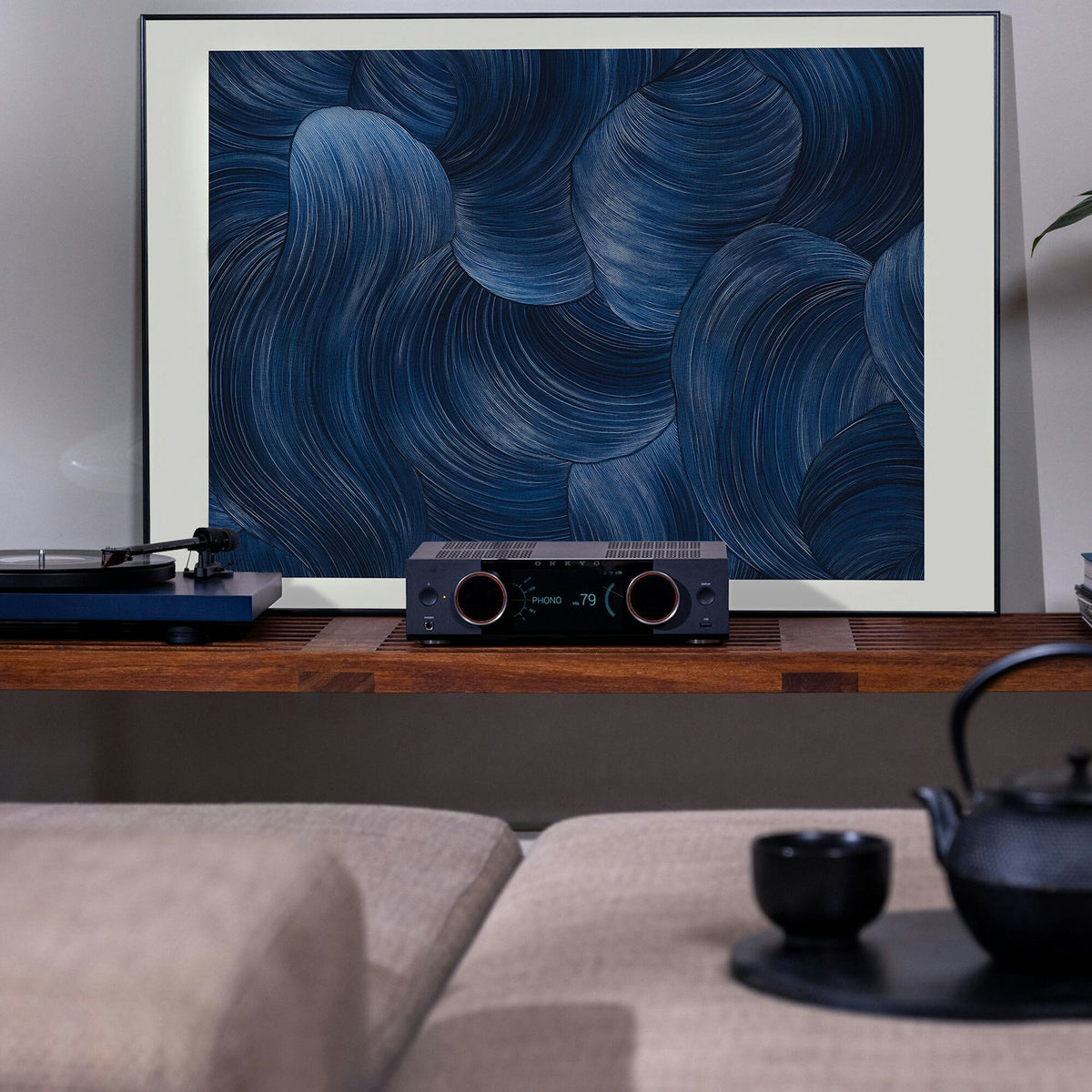
The dedicated phono input accepts compatible moving-magnet and moving-coil cartridges, making the Y-50 useful for a turntable-based system without automatically requiring a separate phono preamplifier. Cartridge output and loading requirements should still be checked for compatibility.
Three pairs of stereo RCA line-level inputs, optical and coaxial digital inputs, and USB-A storage playback accommodate other sources. Stereo RCA pre-outputs are available for compatible external equipment, alongside a dedicated mono subwoofer output and a 6.3mm headphone connection for private listening.
5.46-inch Colour Display and Physical Controls
Easy operation from the rack or listening position
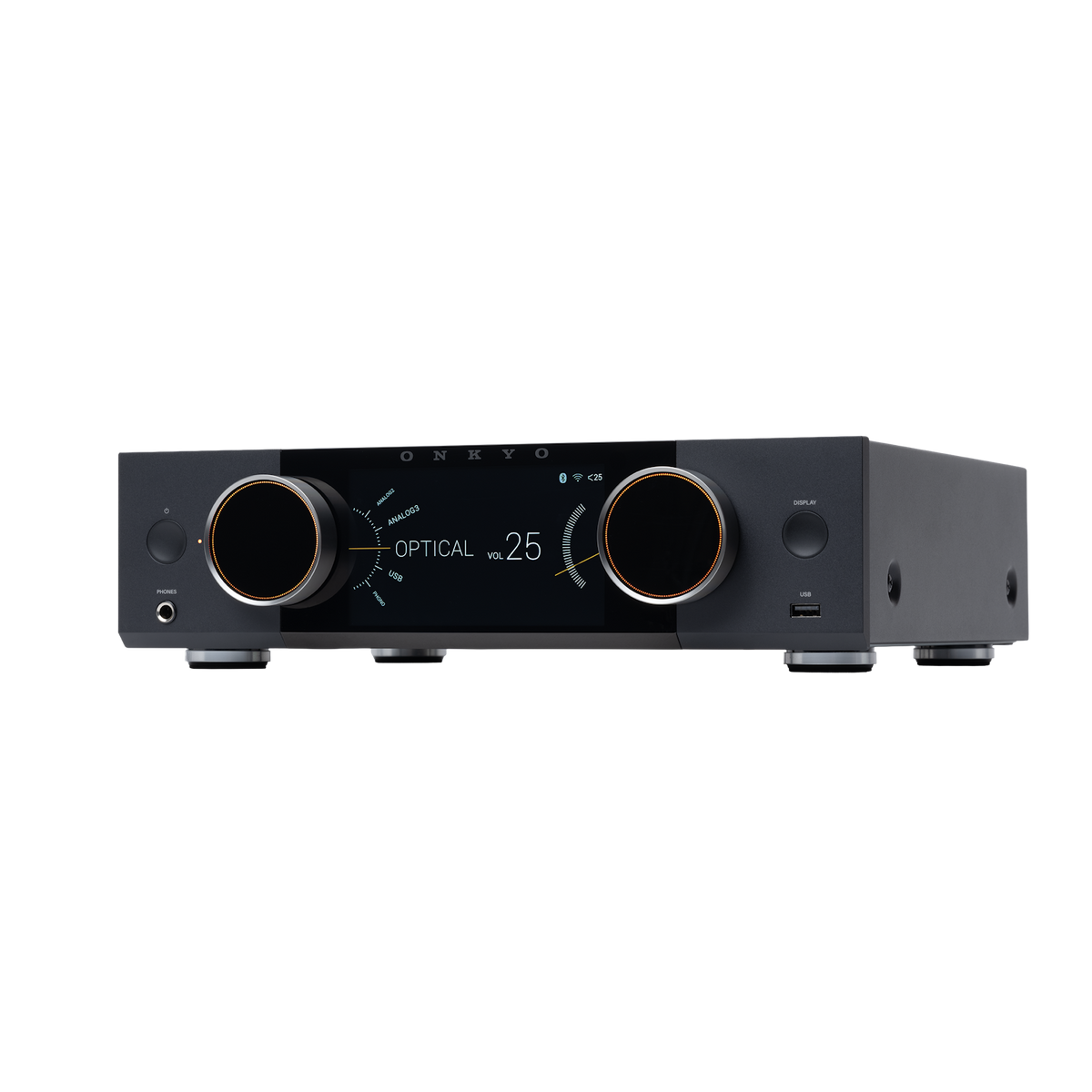
The front-panel LCD can show source and track information along with an analogue-style VU meter presentation. It provides a clear focal point for the amplifier and makes common information visible without opening an app.
Large physical controls, the Onkyo Controller app and the clear on-screen interface give the Y-50 several ways to operate the system. This is particularly useful when the amplifier is shared by people with different preferences for controlling music and television audio.
Compact, Fanless Construction
Consider ventilation and cabling during installation
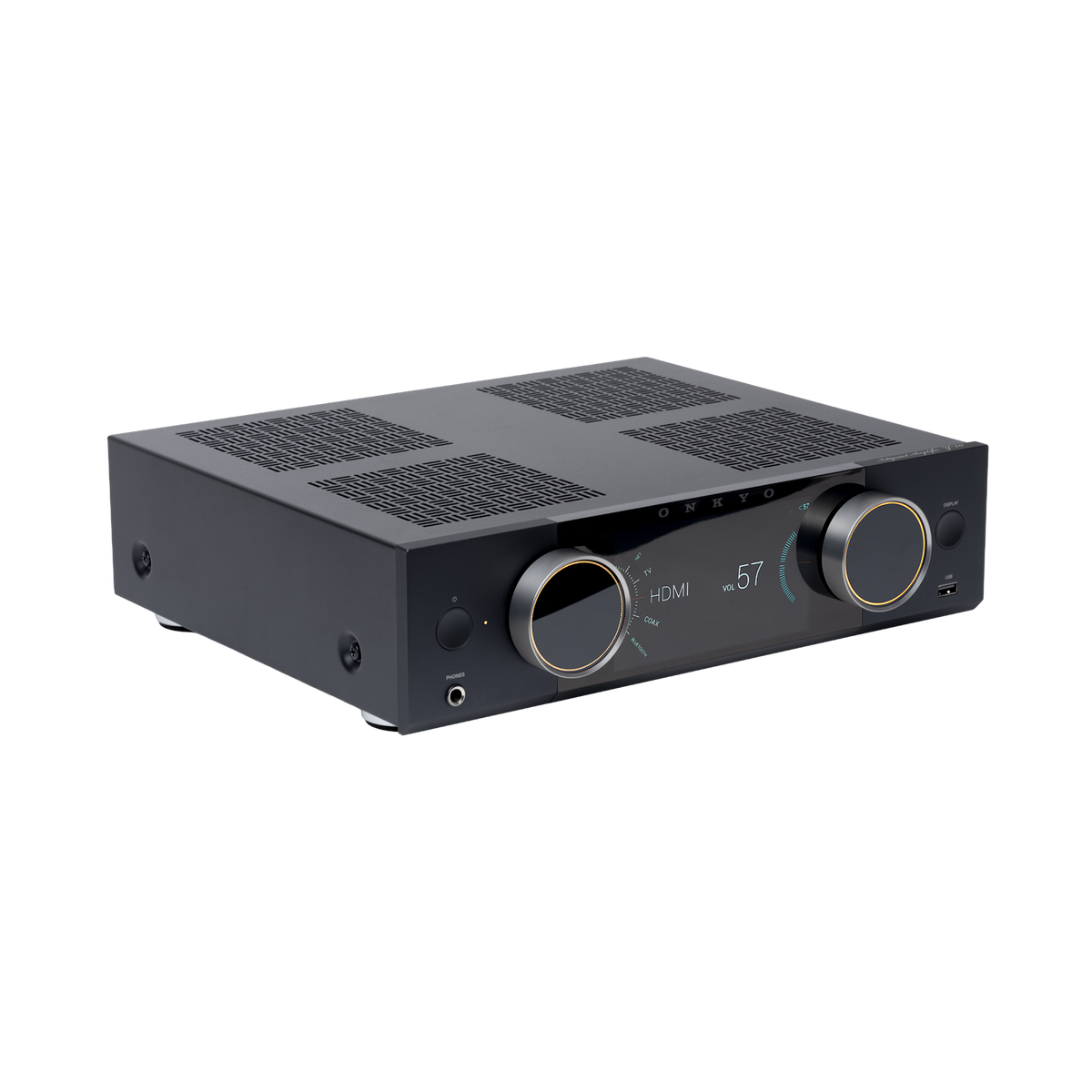
The Y-50 is 350mm wide, 99mm high and 337mm deep, with a net weight of 4.9kg. Its aluminium front panel and San Kuzushi-patterned ventilated top help give the chassis a distinctive appearance while allowing heat to escape. The amplifier is designed to operate without a cooling fan.
Provide appropriate space above the ventilation openings and enough depth behind the unit for HDMI, speaker and power cables. Compact size does not mean it should be enclosed tightly in a cabinet. A stable shelf and sensible airflow are important for long-term use.
Speaker and Subwoofer Matching
Build a balanced two-channel system around the room
The Muse Y-50 is specified for speakers with nominal impedance from 4 to 16 ohms. Its higher output capability opens up a range of potential speaker matches, but room size and listening distance remain central to the choice. A quality bookshelf speaker on stable stands may be right for one room, while a floorstanding model could be more appropriate in another.
The dedicated subwoofer output is useful when a stereo system needs more low-frequency extension or when the main speakers are relatively compact. Placement, crossover settings and level matching will determine how naturally the subwoofer blends with the rest of the system. The Audio Experts can help work through these choices before purchase.
Australian Model and Finish
The verified Australian-market model is Y-50(B)CUM in Black, barcode 4573211155969. Silver is shown internationally but has not been confirmed as an Australian-market configuration. This is the standard Muse Y-50, not the separate 80th Anniversary Special Edition.
Key Features
- Two-channel Axign Class D amplifier with MOSFET outputs
- 250W per channel into 4 ohms or 125W into 8 ohms, at the specified test conditions
- Spotify Connect, TIDAL Connect, Qobuz Connect, AirPlay 2 and Google Cast
- HDMI input and HDMI output with ARC; up to 4K/120p and 8K/60p video pass-through
- Onkyo Room EQ room-calibration system
- MM/MC phono input for a compatible turntable
- Three pairs of stereo RCA inputs plus optical and coaxial digital inputs
- Wi-Fi, Ethernet, Bluetooth and USB-A storage playback
- Dedicated subwoofer output, stereo pre-output and 6.3mm headphone socket
- 5.46-inch colour display with VU meter presentation and a fanless chassis
Specifications
| Specification | Details |
|---|---|
| Brand / model | Onkyo Muse Y-50 |
| Product type | Two-channel network streaming integrated amplifier |
| Amplifier | Axign Class D, MOSFET output |
| Power into 4 ohms | 250W/ch, 1kHz, 0.7% THD, both channels driven |
| Power into 8 ohms | 125W/ch, 20Hz–20kHz, 0.08% THD, both channels driven |
| HDMI | 1 input, 1 output with ARC; up to 4K/120p and 8K/60p pass-through |
| Phono input | Moving magnet and moving coil (MM/MC) |
| Room correction | Onkyo Room EQ |
| Network / streaming | Wi-Fi, Ethernet, Spotify Connect, TIDAL Connect, Qobuz Connect, AirPlay 2, Google Cast |
| Other inputs | 3 pairs RCA line, 1 optical, 1 coaxial, USB-A storage |
| Outputs | Stereo RCA pre-output, mono subwoofer output, 6.3mm headphones |
| Display | 5.46-inch colour LCD |
| Speaker impedance | 4–16 ohms |
| Dimensions (W × H × D) | 350 × 99 × 337mm |
| Net weight | 4.9kg |
| Australian finish / code | Black / Y-50(B)CUM |
| Australian barcode | 4573211155969 |
Detailed Technical Specifications
For those who like to drag out all the useful bits
View full technical specifications
Amplification and Controls
- 2-channel power amplification; 2.1-channel preamplifier configuration
- Axign Class D amplifier architecture with MOSFET output stage
- 250W/ch at 4Ω, 1kHz, 0.7% THD, 2 channels driven
- 125W/ch at 8Ω, 20Hz–20kHz, 0.08% THD, 2 channels driven
- Frequency response: 20Hz–30kHz (+1/−3dB)
- Bass tone adjustment: 100Hz ±10dB
- Treble tone adjustment: 10kHz ±10dB
- Speaker impedance: 4–16Ω
- Onkyo Room EQ room calibration
HDMI and Digital Audio
- HDMI input × 1; HDMI output × 1 with ARC
- HDMI: 4K/120p, 8K/60p, HDCP 2.3
- Supported video features include VRR, QFT, ALLM, QMS, SBTM, DSC, HDR10+ and Dolby Vision
- Optical digital input × 1
- Coaxial digital input × 1
- USB-A × 1 for storage playback
Analogue, Network and Outputs
- Unbalanced stereo RCA line inputs × 3 pairs
- MM/MC phono input × 1 pair
- Stereo RCA pre-output × 1 pair
- Dedicated subwoofer output × 1
- 6.3mm headphone output × 1
- Wi-Fi; Ethernet 10BASE-T/100BASE-TX
- Bluetooth codecs: SBC, AAC
- Spotify Connect, TIDAL Connect, Qobuz Connect, AirPlay 2, Google Cast, network music server support
- Onkyo Controller app
Chassis and Electrical
- 5.46-inch colour LCD with source information and VU display
- Aluminium front panel; ventilated San Kuzushi patterned top
- Fanless temperature-controlled design
- Dimensions: 350 × 99 × 337mm (W × H × D)
- Net weight: 4.9kg
- Package size: 465 × 225 × 405mm
- EMEA/APAC package weight: approximately 7.6kg
- Standby consumption: under 0.4W
- Network standby consumption: under 1.8W
- AC supply: 100–240V, 50/60Hz
Important Notes
- Australian Black model Y-50(B)CUM is verified. The international Silver finish is not confirmed as an Australian-market model and is not included on this listing.
- This is a stereo integrated amplifier, not a multichannel surround sound AV receiver. Check source-device output settings for stereo playback.
- HDMI video compatibility depends on suitable source devices, display, firmware and cabling.
- MM and MC cartridge compatibility should be checked against the turntable and cartridge before ordering.
- USB-A is for storage playback; a computer USB-DAC connection is not specified.
- Streaming services may require subscriptions, compatible devices and network access.
- Leave adequate airflow around the ventilated top and allow space for cabling.
- Australian RRP, stock availability, included accessories and warranty terms should be confirmed before this Draft is published.
The Audio Experts Take
The Muse Y-50 is worth considering when the stereo system needs to do several jobs well: play streamed music, accommodate a turntable, handle television or console audio and, if needed, integrate a subwoofer. The additional HDMI input and output, MM/MC phono compatibility and Onkyo Room EQ are meaningful differences from the Muse Y-40.
The extra amplifier output is useful, but the buying decision should start with speakers, room size and source requirements. We would assess the speaker match, whether a subwoofer is worthwhile, and where the amplifier will sit before treating the power rating as the deciding factor. For customers who want a substantial two-channel system without a rack full of separate electronics, the Y-50 brings together an unusually practical set of connections.
Payment & Security
Your payment information is processed securely. We do not store credit card details nor have access to your credit card information.