


Description
NAD C 3050 Stereophonic Integrated Amplifier
A vintage-inspired 100W-per-channel integrated amplifier that combines traditional hi-fi controls with HDMI eARC, an MM phono stage, modern digital inputs and an MDC2 upgrade path.
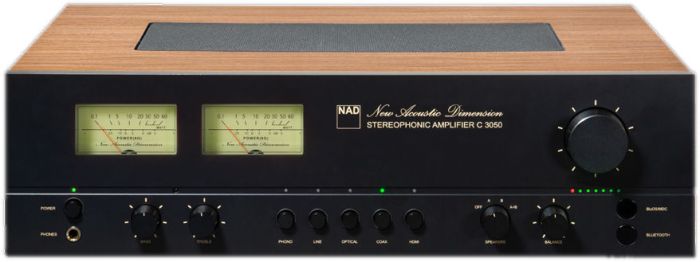
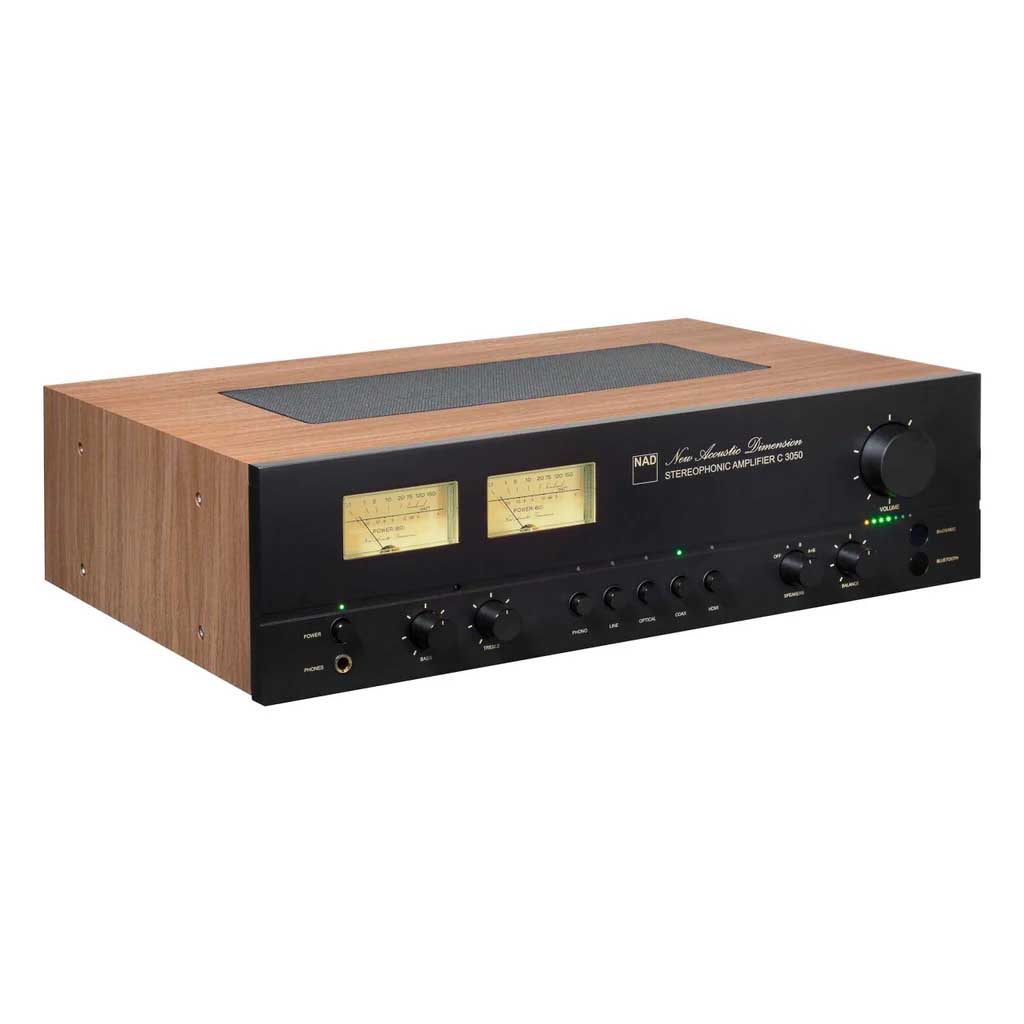
The NAD C 3050 takes its visual cues from the company’s classic 3030 Stereophonic Amplifier. Dual illuminated VU meters, push-button source selection, physical bass and treble controls, cursive NAD branding and a walnut-finished cabinet give it the unmistakable character of a 1970s component.
Underneath that deliberately nostalgic exterior is a thoroughly modern two-channel amplifier. HybridDigital UcD amplification provides 100W per channel into both 8-ohm and 4-ohm loads, while a Texas Instruments differential DAC, HDMI eARC, digital inputs, Bluetooth and an MM phono stage allow the C 3050 to handle a broad mix of current and traditional sources.
Vintage Design Without Vintage Limitations
Physical controls and illuminated meters give the C 3050 a clear identity
The twin VU meters can monitor either the incoming signal or the speaker output, while the front panel provides direct access to source selection, speaker switching, balance, bass, treble and volume. It is purpose-built for customers who prefer tactile operation rather than navigating every basic function through an app or touchscreen.
The cabinet uses a walnut-finished vinyl cladding rather than the conventional black metalwork found across much of the modern amplifier market. Combined with the dark grey front panel and original-style NAD script, the C 3050 is designed to look like part of the listening room rather than disappearing into an equipment stack.
HybridDigital UcD Amplification
100W per channel gives it useful authority across a wide range of speakers
The C 3050 delivers 100W per channel continuously into both 8-ohm and 4-ohm loads with both channels driven. Its published IHF dynamic-power figures rise to 180W into 8 ohms, 250W into 4 ohms and 300W into 2 ohms.
That reserve matters when music moves from quiet passages into short, demanding peaks. It also makes the C 3050 a sensible starting point for medium-sized and larger stereo systems, provided the selected speakers and listening levels are matched properly.
The amplifier’s rated distortion remains below 0.03% from 250mW through to 100W into 8 or 4 ohms. The aim is not merely a large headline power figure, but clean and consistent output across the range in which the amplifier will normally be used.
Analogue, Digital and TV Sources
One amplifier can anchor a turntable, digital source and television system
An ultra-low-noise moving-magnet phono input allows a compatible turntable to connect directly without a separate phono stage. Infrasonic filtering helps reduce very-low-frequency energy caused by record warps and other mechanical effects before it reaches the amplifier and speakers.
For digital equipment, the C 3050 provides one optical and one coaxial input feeding a Texas Instruments PCM5242 differential DAC. A stereo line-level RCA input accommodates an additional analogue source such as a CD player, tuner, external DAC or network streamer.
Built-in aptX HD Bluetooth provides a convenient way to send audio from a compatible phone, tablet or computer to the amplifier. The standard C 3050 supports Bluetooth reception; two-way Bluetooth transmission to wireless headphones is added with the optional MDC2 BluOS-D module.
HDMI eARC for Better Television Sound
A practical way to build a proper two-channel TV and music system
HDMI eARC allows a compatible television to send PCM audio directly to the C 3050. This makes it possible to use the same pair of quality speakers for music, films, television and gaming without adding a conventional multi-channel AV receiver.
HDMI CEC power control can also allow the connected television to switch the amplifier on or into standby. The C 3050’s HDMI connection is an audio-return input rather than a video-switching system, so source devices remain connected to the television.
For a simple 2.0 or 2.1-channel living-room system, this is a particularly useful combination. The amplifier provides the sound quality and speaker-driving capability of a dedicated stereo component while remaining straightforward to use with everyday television viewing.
MDC2 Expansion
BluOS streaming and Dirac Live can be added when the system is ready
The rear-panel MDC2 expansion slot allows compatible functionality to be added without replacing the entire amplifier. Installing the optional MDC2 BluOS-D module adds BluOS high-resolution network streaming, multi-room audio, network connectivity and Dirac Live room correction.
The module includes Dirac Live Limited Bandwidth operation from 20Hz to 500Hz and a calibration microphone. That range covers much of the region where room modes and placement problems tend to create the most obvious response irregularities.
BluOS also provides app control, access to supported streaming services, network-library playback and integration with other BluOS-enabled products. Because MDC2 supports communication in both directions, room correction can be applied to sources connected directly to the amplifier rather than being limited to network-streamed music.
The MDC2 BluOS-D module is optional and is not included with the standard C 3050 covered by this page.
Flexible System Integration
Speaker switching, pre-out/main-in and installer connections leave room to grow
Two sets of speaker outputs support Speaker A, Speaker B or A+B operation. This can be useful for switching between two speaker pairs or feeding a second listening area, although the combined speaker load needs to remain appropriate when both outputs are used together.
A dedicated subwoofer output sends low-frequency content up to 80Hz to a connected powered subwoofer. This gives the C 3050 a clear role in both full-range stereo systems and 2.1-channel arrangements built around smaller main speakers.
Separate pre-out and main-in connections allow the preamplifier and power-amplifier sections to be accessed independently. The C 3050 can therefore operate as a preamplifier with an external power amplifier, or its power stage can be driven by a compatible external preamplifier or processor.
A dedicated 6.35mm headphone output, IR input, 12V trigger output and supplied SR 10 remote control round out a connection set that is equally useful in a traditional stereo system or a more carefully integrated installation.
Key Features
- Vintage-inspired design based on NAD’s classic 3030 amplifier
- Dual illuminated VU meters
- Walnut-finished vinyl-clad cabinet
- Dark grey front panel with original-style NAD script
- HybridDigital UcD amplification
- 100W per channel into 8 ohms and 4 ohms
- IHF dynamic power of 180W into 8 ohms, 250W into 4 ohms and 300W into 2 ohms
- Texas Instruments PCM5242 differential DAC
- Moving-magnet phono input with infrasonic filtering
- One stereo line-level RCA input
- One optical digital input
- One coaxial digital input
- HDMI eARC with CEC power control
- aptX HD Bluetooth reception
- Optional MDC2 BluOS-D streaming and room-correction expansion
- Speaker A and Speaker B outputs
- Powered-subwoofer output
- Pre-out and main-in connections
- Dedicated headphone amplifier
- Bass, treble and balance controls
- IR input and 12V trigger output
- SR 10 remote control included
Specifications
| Specification | Details |
|---|---|
| Product type | Two-channel stereophonic integrated amplifier |
| Model | NAD C 3050 |
| Australian distributor product code | NA-DC3050 |
| GTIN | 786357002231 |
| Amplifier platform | HybridDigital UcD |
| Continuous output power | 100W per channel into 8 ohms or 4 ohms, 20Hz–20kHz, both channels driven |
| Rated THD | Less than 0.03% from 250mW to 100W into 8 or 4 ohms |
| Clipping power | Greater than 115W at 1kHz and 0.1% THD |
| IHF dynamic power | 180W into 8 ohms, 250W into 4 ohms, 300W into 2 ohms |
| Peak output current | Greater than 20A into 1 ohm for 1ms |
| Frequency response | ±0.3dB, 20Hz–20kHz |
| DAC | Texas Instruments PCM5242 differential DAC |
| DAC architecture | 32-bit/384kHz |
| Analogue inputs | 1 x stereo RCA line input, 1 x MM phono input |
| Digital inputs | 1 x optical, 1 x coaxial |
| TV connection | 1 x HDMI eARC audio input |
| Bluetooth | aptX HD Bluetooth 5.0 reception |
| Speaker outputs | Speaker A and Speaker B binding posts |
| Subwoofer output | 1 x RCA, low-frequency content up to 80Hz |
| Other analogue connections | Stereo pre-out and main-in |
| Headphone output | 6.35mm stereo jack |
| Control connections | IR input and 12V trigger output |
| Expansion | 1 x MDC2 module slot |
| Front-panel controls | Bass, treble, balance, source selection, speaker selection and volume |
| Dimensions (W x H x D) | Approximately 450 x 127 x 355mm, including external projections |
| Net weight | 10kg |
| Shipping weight | 12.6kg |
| Cabinet finish | Walnut-finished vinyl cladding |
| Front-panel finish | Dark Grey |
| Included accessories | SR 10 remote control with batteries, Bluetooth antenna, quick setup guide and detachable mains power cords |
Detailed Technical Specifications
For those who like to drag out all the useful bits
View full technical specifications
Power Amplifier
- Amplifier technology:HybridDigital UcD
- Continuous output power:100W per channel into 8 ohms or 4 ohms
- Measurement condition:20Hz–20kHz at rated THD, both channels driven
- THD, 20Hz–20kHz:Less than 0.03% from 250mW to 100W into 8 or 4 ohms
- Signal-to-noise ratio:Greater than 95dB, A-weighted, referenced to 1W into 8 ohms
- Clipping power:Greater than 115W at 1kHz and 0.1% THD
- IHF dynamic power into 8 ohms:180W
- IHF dynamic power into 4 ohms:250W
- IHF dynamic power into 2 ohms:300W
- Peak output current:Greater than 20A into 1 ohm for 1ms
- Frequency response:±0.3dB from 20Hz to 20kHz
- Channel separation:Greater than 75dB at 1kHz and greater than 70dB at 10kHz
- Input sensitivity for 100W into 8 ohms:540mV analogue or -6dBFS digital
Line-Level Preamplifier
- THD, 20Hz–20kHz:Less than 0.005% at 2V output
- Signal-to-noise ratio:Greater than 95dB, IHF A-weighted
- Channel separation:Greater than 100dB at 1kHz and greater than 90dB at 10kHz
- Input impedance:28 kilohms plus 360pF
- Maximum input signal:Greater than 4.5Vrms
- Output impedance:440 ohms
- Input sensitivity:270mV for 500mV output
- Frequency response:±0.3dB from 20Hz to 20kHz
- Maximum preamplifier output:Greater than 2V into an IHF load
Moving-Magnet Phono Stage
- Cartridge compatibility:Moving-magnet cartridges
- Filtering:Infrasonic filtering circuitry
- THD, 20Hz–20kHz:Less than 0.03% at 2V output
- Signal-to-noise ratio:Greater than 79dB, 200-ohm source, A-weighted
- Input impedance:46 kilohms / 100pF
- Input sensitivity:5.5mV for 500mV output
- Frequency response:±0.3dB from 20Hz to 20kHz
- Maximum input signal at 1kHz:Greater than 80mVrms
- Ground terminal:Included for compatible turntable earth connection
Headphone Amplifier
- Connection:6.35mm stereo headphone jack
- THD, 20Hz–20kHz:Less than 0.005% at 1V output
- Signal-to-noise ratio:Greater than 96dB with a 32-ohm load
- Frequency response:±0.3dB from 20Hz to 20kHz
- Channel separation:Greater than 60dB at 1kHz
- Output impedance:2.2 ohms
- Controls available during headphone use:Volume, bass, treble and balance
Inputs and Outputs
- Analogue line input:1 x stereo RCA
- Phono input:1 x stereo RCA for moving-magnet cartridges
- Optical digital input:1
- Coaxial digital input:1
- HDMI input:1 x HDMI eARC audio-return input
- HDMI audio format requirement:PCM
- Speaker connections:Two independently selectable pairs
- Speaker selection:A, B, A+B or Off
- Subwoofer output:1 x RCA
- Subwoofer signal:Low-frequency content up to 80Hz
- Preamplifier output:Stereo RCA
- Main input:Stereo RCA
- Remote-control input:IR in
- System-control output:12V trigger out
- Bluetooth antenna connection:Included
Bluetooth
- Bluetooth version and quality:aptX HD Bluetooth 5.0
- Standard C 3050 operation:One-way reception from a compatible source device
- Bluetooth source selection:Front-panel touch control
- Bluetooth transmission to headphones:Requires the optional MDC2 BluOS-D module
Optional MDC2 BluOS-D Module
- Included with standard C 3050:No
- Network connections:Wi-Fi and Gigabit Ethernet
- Streaming platform:BluOS
- Multi-room support:BluOS-enabled multi-room audio
- Supported audio resolution:Up to 24-bit/192kHz
- Supported integrations include:AirPlay 2, Spotify Connect and TIDAL Connect
- Room correction:Dirac Live Limited Bandwidth
- Included Dirac operating range:20Hz–500Hz
- Calibration microphone:Included with the MDC2 BluOS-D module
- Correction support:Can be applied to compatible sources connected to the C 3050
- Bluetooth with module installed:Two-way receive and headphone-transmit modes
Front-Panel Operation
- Metering:Dual illuminated VU meters
- VU meter modes:Input signal or speaker output
- Tone controls:Bass and treble
- Balance control:Left/right balance with centre detent
- Source buttons:Phono, Line, Optical, Coaxial and HDMI
- Additional source controls:Bluetooth and BluOS/MDC
- Speaker selector:A, B, A+B or Off
- Volume indication:LED level indicators
- Remote control:NAD SR 10
Physical and Installation
- Current published dimensions:Approximately 450 x 127 x 355mm
- Dimensions include:Feet, front control projections and rear terminals
- Net weight:10kg
- Shipping weight:12.6kg
- Recommended ventilation clearance:At least 100mm at the left, right, rear and top
- Placement:Firm, level and well-ventilated surface
- Cabinet:Walnut-finished vinyl cladding
- Front panel:Dark Grey
- Standby consumption:0.5W with network standby disabled
- Network standby consumption:2W
- Power-off consumption:0.1W
Included Accessories
- SR 10 remote control
- Two AA batteries
- Bluetooth antenna
- Quick setup guide
- Detachable mains power cords
Important Notes
- This page covers the standard-production NAD C 3050, not the discontinued C 3050 LE limited-edition model.
- The MDC2 BluOS-D module is optional and is not included with the standard amplifier.
- BluOS network streaming, Dirac Live room correction, Wi-Fi, Ethernet, AirPlay 2 and two-way Bluetooth require the optional MDC2 BluOS-D module.
- The built-in Bluetooth connection supports receiving audio from a compatible source. Bluetooth transmission to wireless headphones requires the optional module.
- The HDMI eARC port receives audio from a compatible television. It does not provide video switching or video output.
- The connected television or source should be configured to output PCM audio through HDMI eARC.
- The phono input supports moving-magnet cartridges. A low-output moving-coil cartridge normally requires a suitable external phono stage or step-up device.
- The C 3050 requires passive speakers of an appropriate impedance and capability.
- When Speaker A and Speaker B are used simultaneously, the combined speaker load should be checked before operation.
- The subwoofer output carries low-frequency information up to 80Hz. Subwoofer crossover and level settings should be coordinated with the main speakers and room.
- Allow at least 100mm of ventilation space at the sides, rear and top. Do not install the amplifier in a sealed cabinet.
- Published dimensions vary slightly across NAD documentation. Confirm the required cabinet or shelf space before building the amplifier into tightly fitted furniture.
- Current price, stock, bundled-module configuration and warranty terms should be confirmed before ordering.
The Audio Experts Take
The standard C 3050 is the version to choose when you like the retro NAD format but want to keep streaming as a separate decision. It already covers the core analogue and digital duties of a modern integrated amplifier, and the MDC2 slot leaves an upgrade path if BluOS and Dirac become important later. Talk to us about your sources and speakers and we can help decide whether to buy the base amplifier or move straight to the BluOS-equipped version.
Payment & Security
Your payment information is processed securely. We do not store credit card details nor have access to your credit card information.